
Summary
• From mission schools to global transformation programmes
• Led change initiatives impacting 80,000+ people across 18 countries
• Built businesses by helping people adapt, grow, and lead through uncertainty
• Believes curiosity is what keeps seasoned professionals relevant
Cultural expectations surrounding the elderly are being challenged today, and with good reason!
While it was the norm to slow down and retreat into a quieter life post-retirement, more men and women are finding purpose and joy in doing the opposite.
WisdomCircle honours such men and women by shining light on their journey through an inspiring series called “Wisdom Stories”. These people have successfully smashed stereotypes, and their stories remind us that life should be lived to the fullest, no matter what age or stage.
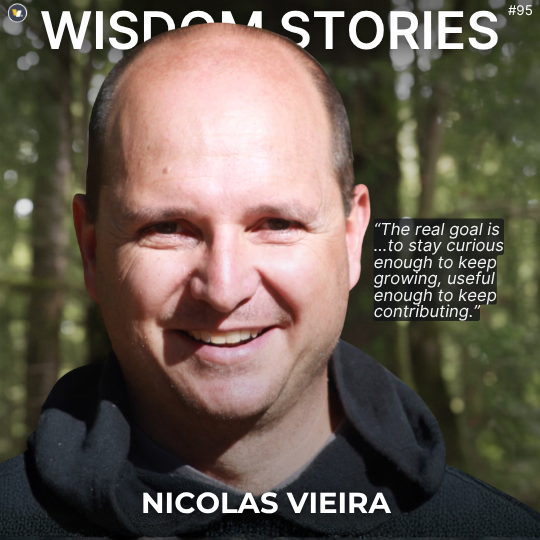
Part of the WisdomCircle cohort, Nicolas Vieira represents a growing group of seasoned professionals redefining what long-term contribution looks like. Based in Dublin, he has spent more than three decades working across education, leadership development, organisational transformation, and large-scale technology implementation.
From building training businesses in South Africa to leading global change programmes across multiple countries, his work today sits at the intersection of people, leadership, and technology.
What stands out, however, is not the scale of the programmes he leads, but the philosophy behind them: curiosity, mentorship, and helping people navigate change with confidence.
“I’ve spent most of my life helping people navigate change. First through education. Then through leadership development. Today, through technology transformation programmes that have global impacts. The medium changed. The purpose never really did.
I grew up in South Africa during apartheid. We were four kids, raised in a rougher area, and like many young men at the time, I had to complete two years of army service. Looking back, those early years taught me something important about systems, power, and people. You see how environments shape behaviour. You also learn very quickly that people adapt when they have no choice.
My first career was in education. Honestly, I chose physical education because it meant I could spend four years playing sport and leave with a degree. It seemed like a good deal at the time. But after university, I found myself drawn toward something deeper. I ran a mission school and worked with organisations across Africa helping communities build schools, libraries, and leadership structures. That phase of my life was very purpose-driven.
Eventually, reality catches up. You have a family to support. I moved into business and started a training company focused on leadership development. That decision changed everything.
Around 2008, I hit one of the real turning points of my career. A friend who had also started a training business invited me to join him. I told him I didn’t want a job. I wanted to build something alongside him. So we negotiated, I became a shareholder, and together we built a national training business in South Africa.
At the time, new legislation required thousands of people in the financial services industry to become accredited. We created the qualifications, built the systems around them, and over five years trained roughly 8,000 professionals across the country. What started with two people became a serious operation with consultants, delivery teams, and national reach.
But success teaches you something else too: every model has a shelf life.
Once the market became saturated, I had to decide whether to keep forcing growth or evolve again. That led me into organisational change management and large-scale technology implementation. I joined an SAP transformation programme for the City of Cape Town, helping manage change across a massive public-sector implementation.
That period reshaped how I thought about leadership.
Technology projects are never really technology projects. They are people projects. You are asking individuals, teams, and organisations to let go of familiar ways of working and trust something new. My role became less about systems and more about helping people transition through uncertainty.
That is where seasoned professionals create disproportionate value.
When you have spent decades working across industries, cultures, teams, and leadership environments, you stop focusing only on execution. You begin shaping strategy, alignment, decision-making, and organisational confidence. Experience allows you to see patterns earlier, anticipate resistance faster, and guide organisations through complexity without creating panic.
I now work on global transformation programmes spanning multiple countries, hundreds of sites, and tens of thousands of people. The technical side matters, of course. But as you become more seasoned, your value shifts. I work with people younger and technically sharper than me all the time. My role is no longer to be the smartest person in the room. It is to create the conditions where others can succeed.
That, to me, is what staying relevant actually means.
People think relevance is about keeping up with tools or trends. Those things matter, but the deeper question is whether you remain curious. The moment you lose curiosity, you begin becoming irrelevant, regardless of your age.
I still see myself as an educator. I simply use technology as the medium now. Whether I’m leading a transformation programme or mentoring someone early in their career, the work is still about helping people navigate change and become better versions of themselves.
And mentorship, for me, is often misunderstood.
It is not about having all the answers or telling people what to do. It is about creating environments where people feel safe enough to try, fail, recover, and grow. The best leaders create space. They do not control every outcome. As you become more senior, your responsibility becomes less about being the hero and more about enabling others to perform at their best.
That philosophy has become even more important as I think about the next phase of my own life.
I’m fifty-five now. My children are grown. My wife and I have moved countries, rebuilt our lives in Ireland, and started over more than once. I still work hard, but I think differently about success these days.
I want to build something sustainable over the next decade. I want the freedom to choose how much I work, when I work, and what I work on. That requires planning, continued learning, and staying sharp in my field. But it also requires perspective.
At some point, all of us stop working. At some point, all of us stop living. Knowing that changes how you make decisions.
So today, I make decisions not only for income, but for future choice. I think carefully about the life I want ten years from now and whether the decisions I make today move me closer to that.
Because in the end, the real goal is not simply to stay busy.
It is to stay curious enough to keep growing, useful enough to keep contributing, and wise enough to know when to let others step forward.”
Interviewed by Nehal Naik for WisdomCircle
Explore more inspiring journeys—read more Wisdom Stories here.


