
Summary
• Curiosity is often the beginning of life's most meaningful journeys.
• Stewardship means protecting what we inherit and ensuring it reaches future generations.
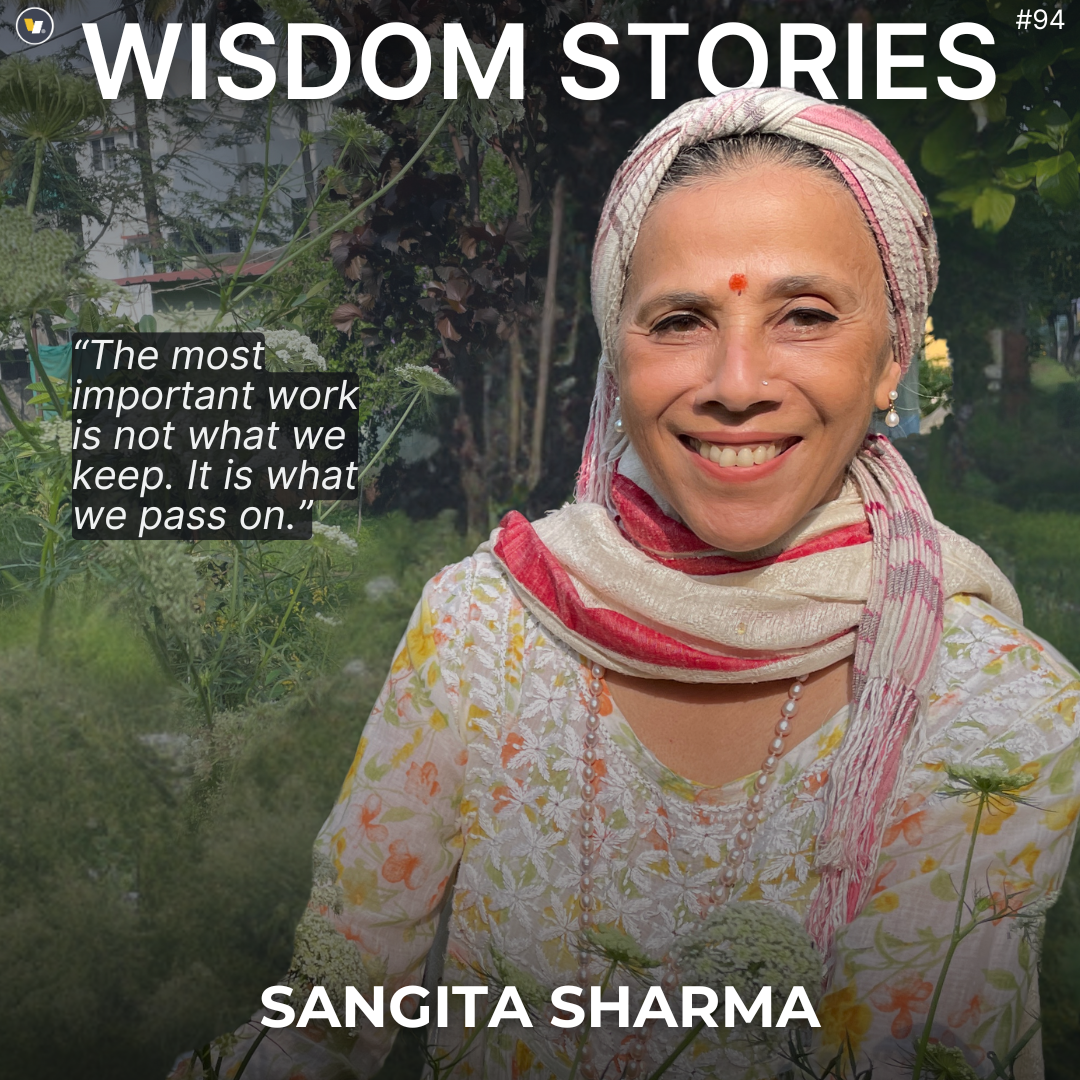
• The value of experience lies not in what we keep, but in what we pass on.
• Sustainability depends on coexistence, responsibility, and long-term thinking.
• Lasting impact comes from nurturing people, knowledge, and ecosystems beyond us.
• The greatest legacy is leaving something stronger for those who come after us.
Cultural expectations surrounding the elderly are being challenged today, and with good reason!
While it was the norm to slow down and retreat into a quieter life post-retirement, more men and women are finding purpose and joy in doing the opposite.
WisdomCircle honours such men and women by shining light on their journey through an inspiring series called “Wisdom Stories”. These people have successfully smashed stereotypes, and their stories remind us that life should be lived to the fullest, no matter what age or stage.
‘Aham Beejam Annahi Purna Brahma’ to mean ‘I am the seed, and the seed is the reflection of the cosmos.‘
“When I first came across this in our Vedic scriptures, it stopped me in my tracks.
Until then, I had simply followed a question that had been growing inside me for years: What is this astonishing gift of life that sits inside a seed?
I had no idea that question would reshape the rest of my life.
I was born and raised in what was then the wilderness on the outskirts of Bangalore, on a remote farm in Singapura. My father, an ex-Army officer, was a true visionary and remains my greatest inspiration. He was far ahead of his time in the way he thought about farming, land, and nature.
Growing up, my greatest joy was simply being outdoors. Playing in the soil. Building sandcastles. Observing the flora and fauna around me. Nature was my companion.
Getting to school was an adventure. I travelled by tonga, tractor, bicycle, and sometimes on my own two legs, often covering eighteen kilometres. I loved eating wild fruits along the way. Looking back, those journeys taught me far more than any classroom. Every spare moment was spent on curiosity and observation.
After college, armed with an Economics degree from Mount Carmel, I wanted to test my mettle against the molten brands in the corporate world. Starting in 1986, I built a career across multiple industries from travel, media, fashion, PR, branding taking on challenges, learning constantly, and giving every role my absolute best.
But I did something that was considered unusual.
I would reach a position of success, often the pinnacle of success within an organisation, and then completely reinvent myself.
I would take a year-long sabbatical to explore a new adventure in life. It was like diving into the deep end of the ocean, surfacing, and then choosing an entirely different ocean to explore.
Those years gave me tremendous learning. Leading a high-flying corporate life was both materialistic & stressful in nature. Consuming fast food and falling prey to toxic eating habits leading to chronic illness, frequent hospital visits, and heavy reliance on pharmaceuticals, a vicious cycle fuelled by even more processed foods and ailments. Everything felt completely out of sync. I experienced a severe reality check and began questioning the very meaning of my existence, particularly the hidden dangers in the food we ate.
My sister spurred me further by highlighting the processed food I routinely indulged in. “Read the fine print on the labels!” she urged. When I finally did, the ugly truth unravelled: a hidden world of chemicals, additives, emulsifiers, colorants, and preservatives. It was a powerful revelation that forced deep, personal questions: Where does my food come from? Why am I subjecting myself and my loved ones to pesticide-laden food? Is our food nourishing us, or is it consuming us with toxicity?
My transition from Corporate Affairs into agriculture began in 2001 when I relocated back to India. I had no plan, no expectations, and no clue what the future had in store for me—just an inner call that beckoned me back to my roots. A Zorban dictum gnawed at me: “Man needs a little madness, or else he would never dare cut the rope to be free”. It took that little bit of madness to cut the corporate rope.
In search of answers about our food system, I travelled the length and breadth of India, only to uncover shattering realities. Firstly, our farmers who feed us, go to bed hungry each night. With no access to their seeds, farmers had to purchase patented seeds along with corrosive chemicals at extortionate prices leading to debt and death by suicide witnessed first-hand. Indigenous seeds tragically were no longer the farmers’ legacy. This was a rude shock to my system. Second, by abandoning traditional, time-tested agricultural methods, diverse and nourishing foods were fast disappearing, replaced by a handful of commercial crops heavily laced with pesticides and herbicides. Finally, our agricultural policies were fundamentally faulty not supportive of sustainability.
My love for food compelled me to trace everything back to its source.
The seed.
As I researched further, I became fascinated. Here was a living embryo carrying generations of knowledge, resilience, and adaptation. Yet we were losing thousands of indigenous varieties. Many of the traditional foods I had grown up with were fast disappearing. Diversity was shrinking.
What started as curiosity became a mission.
That journey eventually gave birth to Annadana Soil and Seed Savers Network. Annadana to mean “the gift of Seed & food,” and the idea was simple: conserve indigenous seeds, multiply them, and return them to communities so that farmers could regain seed sovereignty and food autonomy.
Over the years, our work expanded from seed conservation to the entire ambit of regenerative agriculture with publications, films, and education programmes galore.
‘Seeing is believing’ our food forests knowledge hubs with a Seed Bank showcases sustainability in Bengaluru city & Annadana Siragoli, Western Ghats. Our experiential centres for learning have trained thousands of farmers, students from all walks, garden enthusiasts, researchers, policy makers and curious citizens who have walked our living fields themed ‘Soil to Seed to Plate’ to reconnect with the source of their food.
From our living fields initiatives across India, our goal was to armour farmers to take charge of their genetic wealth and be the custodians of their seed legacy. So, How do we do this? We at Annadana, follow the forest principle & sow seeds of sustainable thinking by applying ancestral wisdom with inclusive technology one which is not corrosive.
We empower farmers & invest in their youth in regenerative agriculture practices. This knowledge exchange lends itself to the Best practices with an ecological balance & economic growth.
As solution providers, we have transformed degraded soil be it saline, drought, barren, pesticide laden to thriving food forests across India.
26 years hence, with no science background nor academic qualifications in agriculture, my journey with the seed has only reaped me abundance.
But the work has never really been about seeds.
It has always been about relationships.
Our relationship with the soil. Our relationship with food. Our relationship with each other. And our relationship with future generations.
The soil is an expectant mother into which we feed life-giving nutrients & not toxic chemicals. The soil is a mirror reflection of our gut. What we feed her is ultimately what we feed ourselves.
In our 60s, my husband and I stand as a living proof of this synergy. Our vitality is not accidental; Food is medicine, and ancestral crops are the ultimate healers.
Today, when people ask me what drives me, the answer is the same curiosity that guided me as a child walking eighteen kilometres to school through fields and forests.
I still believe learning begins with observation.
I still believe nature; her forests are our greatest teacher.
I still believe the seeds of success are best nurtured by an enthusiastic interest.
I still believe genetic wealth is our health. A healthy soil reaps healthy seeds, healthy plants & fruits & in turn a Healthy us!
Every seed carries a history, a culture with nourishing traditions, a story much bigger than ourselves’. We are only the temporary custodians. Seeds are gift to life and must flow forever.
‘The real question is what we choose to pass on.’
Having said that, I am delighted to share a milestone achievement that brings this philosophy to life: the Annadana Seed Legacy was recently gifted back to my roots in Punjab.
The progressive farmers empowered by our journey have now replicated our scalable food forest hubs. They are proving that we do not need to fight the land to feed our people; we simply need to coexist with it.
As I have always stated: “If we are Seed Secure, we are Food Secure.” Our agro-ecology hubs demonstrate this truth every single day.
A Final Thought to take away.
Each one of us can make a difference. The real question we face is simple: Are we leaving behind a legacy of exhaustion, or are we planting the seeds of a resilient future?
The choice is ours. Let us choose to be seed secure. Let us choose to be Earth Wise.”
A Few Thoughts I Live By:
- ‘Treat your body like a temple, not a human dustbin.’ Food is meant to heal us. In our 60s, we are living testimony to the power of dense micronutrients found in chemical free indigenous crops.
- ‘The forest is my blueprint.’ We don’t invent; we simply follow the forest principle in all our projects.
- ‘Growing food is no rocket science.’ If I can do it, absolutely anyone can.
Curiosity Talks #50
Sangita Sharma joins the 50th edition of Curiosity Talks on 26 June for EarthWise: Wisdom Shaping Sustainable Futures – The Art of Stewardship in a Changing World. Drawing on a journey that spans corporate leadership, regenerative agriculture, indigenous seed conservation, and community learning, Sangita will explore what stewardship truly means in a rapidly changing world. Her work offers a powerful reminder that sustainability begins not with ownership, but with responsibility, for our soil, our food systems, our knowledge, and the generations that follow. Register here: https://luma.com/twdtx95s
Interviewed by Nehal Naik for WisdomCircle
Explore more inspiring journeys—read more Wisdom Stories here.


