
Summary
• Experiencing retrenchment as both employee and HR manager
• Building a “Plan B” long before needing one
• Working full-time while continuously studying and upgrading
• Leaving a stable banking career in search of growth and exposure
• The psychological impact of job loss beyond income
• Creating spaces for honest conversations around resilience and reinvention
Cultural expectations surrounding the elderly are being challenged today, and with good reason!
While it was the norm to slow down and retreat into a quieter life post-retirement, more men and women are finding purpose and joy in doing the opposite.
WisdomCircle honours such men and women by shining light on their journey through an inspiring series called “Wisdom Stories”. These people have successfully smashed stereotypes, and their stories remind us that life should be lived to the fullest, no matter what age or stage.
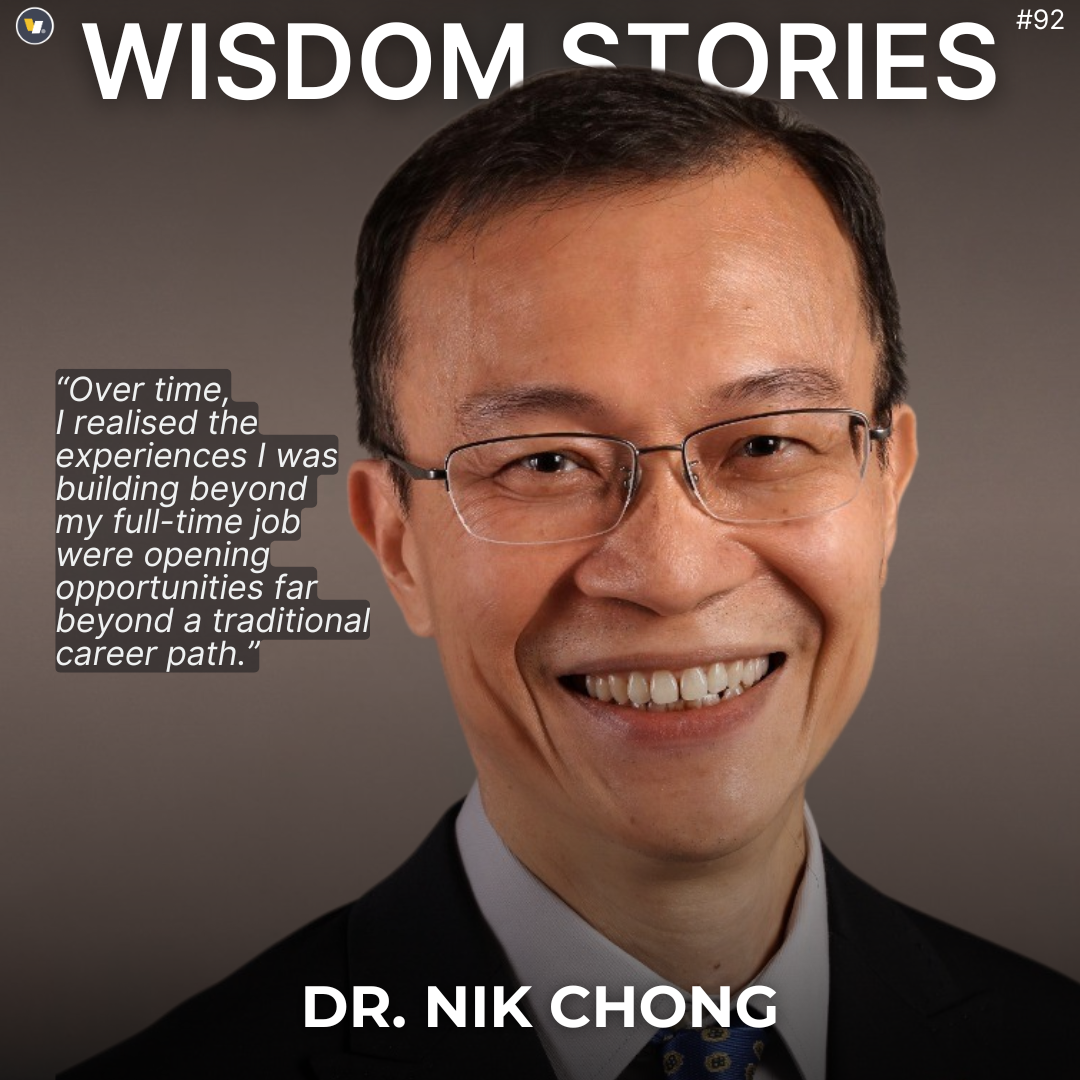
Dr Nik Chong has spent decades across banking, recruitment, human resources, consulting, and leadership development. Over the years, he worked across Japanese multinationals, local companies, and global engineering firms, while simultaneously studying, teaching, and building parallel paths beyond corporate life.
When we sat down with Nik, what stood out was not just his career journey, but how deeply two experiences with retrenchment shaped the way he thinks about work, relevance, and resilience today.
“I still remember being the second-last person to leave the office.
The company was going through restructuring. One by one, people packed their things and left. I had to type out all the retrenchment letters, hand over the keys to my boss, and close the department.
At that point in my life, I had just gotten married. My twin daughters were about one year old. During the day, I was working full-time. At night, I was studying for my bachelor’s degree.
That experience stayed with me for a very long time.
I was never a very strong student growing up. Average student, but hardworking. I did not have the grades to enter university after junior college, so after my A-levels, I went into national service (NS).
During NS, I realised many of my peers were much better qualified than me. In Singapore, qualifications mattered a lot. I remember thinking, ‘If everybody is already at this level, what chance do I stand when I enter the job market?’
So, while serving NS, I started taking evening classes and professional diplomas, including courses with the Chartered Institute of Marketing. That became a pattern throughout my life. I was never really a full-time student. I was always working and studying at the same time.
My first job was in banking because everybody said banking was a safe industry. After about six months, I found it monotonous and moved into a recruitment agency specialising in engineers and technical professionals. That was where I first learned recruitment, interviewing, and HR.
From there, I moved into broader human resource management roles across Japanese multinationals, local companies, and later an American-British engineering company. I wanted exposure and experience across the whole spectrum; recruitment, payroll, unions, restructuring, management.
That engineering company was where I experienced retrenchment for the first time.
I joined during a restructuring exercise without really knowing what I was walking into. I was young, newly married, and just focused on building a career. But eventually, the department got absorbed into a larger organisation, and I became the second-last person left to close the department.
That experience changed the way I looked at work permanently.
Later, when I joined another Japanese company as an HR manager, I started seeing restructuring happen across industries again. By then, it was the early 2000s. I was in my late 30s or early 40s and doing my MBA part-time in the evenings.
I remember thinking very clearly: if this happened to me once, I did not want to be caught unprepared the next time.
That’s when I experienced retrenchment from the other side.
As an HR manager, I had to conduct retrenchments myself. One case I still remember was when the company moved into a more high-tech office building and decided they no longer needed a receptionist. The receptionist had been with the company for almost 20 years and was already in her late 40s or close to 50.
I had to carry that message to her.
Honestly, that felt even worse.
People do not just lose income. They lose confidence, identity, and sometimes their sense of self-worth. Many still blame themselves even when the situation has nothing to do with capability or effort.
That is why retrenchment remains something very close to my heart.
Around that period, I had a friend running a training and consulting company. I asked if I could learn from him and help after office hours and on weekends while still holding my full-time job.
That became my Plan B.
I started networking heavily, taking on consulting assignments, conducting workshops, and teaching part-time at universities. Along the way, I realised these experiences were opening opportunities far beyond a traditional career path.
By 2005, I felt I had built enough experience and confidence to leave full-time employment and move fully into consulting, training, and teaching.
Even then, I kept studying. Eventually, in 2019, I completed a Doctorate in Business Administration with the University of Canberra while still working full-time. It took me six years.
In 2025, together with my friend Sebastian Chen and a group of community partners, we started organising ‘Voices from the Heart’ sessions in Singapore, open platforms where ordinary people can share stories about retrenchment, caregiving, recovery, failure, and resilience.
We wanted to create a space where people feel heard without judgement.
Because at the end of the day, everybody wants to feel useful.
Nobody wants to feel irrelevant.
That is human nature.”
Interviewed by Nehal Naik for WisdomCircle
Explore more inspiring journeys—read more Wisdom Stories here.


